

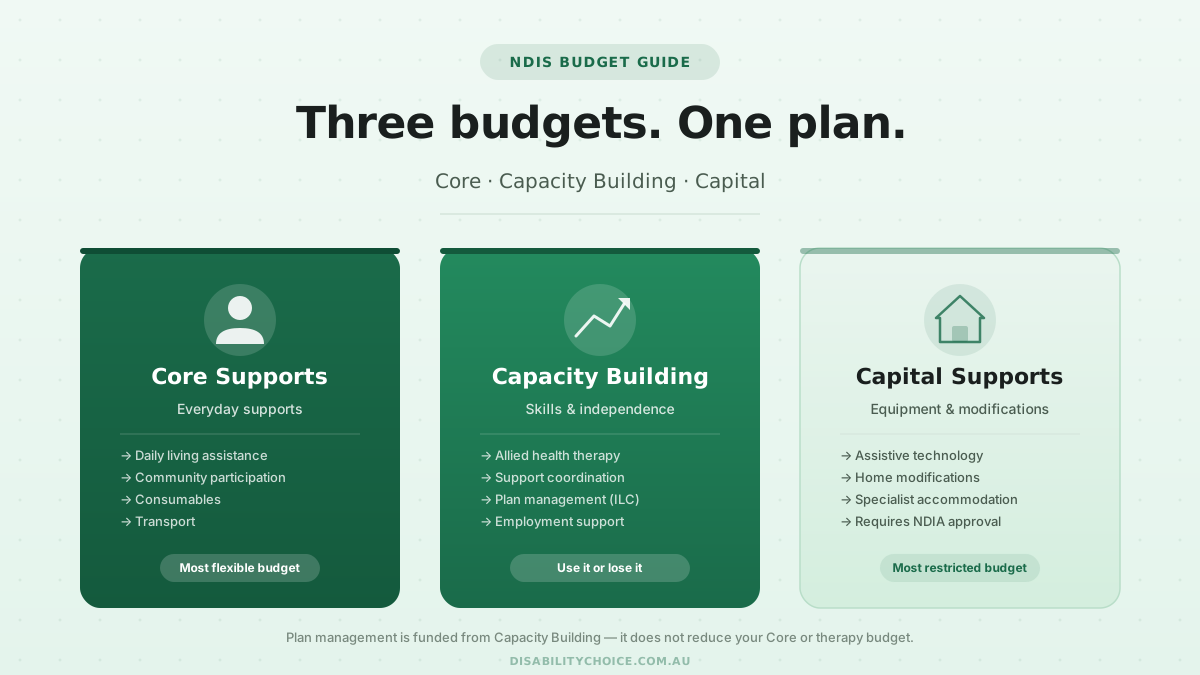
NDIS budget categories explained: if you have just received your first NDIS plan, or you are preparing for a plan review, understanding how your funding is divided is the first thing to get right. There are three main budget categories — Core Supports, Capacity Building Supports and Capital Supports — and each one works differently in terms of what you can spend it on, how flexible it is, and whether unspent funds carry over. This article explains all three in plain Australian English, with no jargon and no guesswork.
Core Supports
Core Supports is the budget category most participants spend the most money from, and it is also the most flexible. Core funds your day-to-day supports — the things you need to live your life and participate in your community. Unlike the other two categories, most Core Supports funding can be moved across its sub-categories without needing NDIA approval, which gives you useful flexibility if your needs shift throughout the year.
There are four sub-categories within Core Supports:
- Assistance with Daily Activities — support worker help with your morning routine, personal hygiene, meal preparation, household tasks like cleaning and laundry, and overnight or 24-hour care where needed.
- Assistance with Social, Economic and Community Participation — support to access your community, attend social activities, join a club, go on a community outing, or participate in recreational activities alongside other people.
- Consumables — lower-cost items you use regularly, such as continence products, wound dressings, low-risk assistive technology under $1,500, or nutritional supplements where these are funded by the NDIA. Our complete NDIS consumables guide covers exactly what you can claim and how.
- Assistance with Social, Economic and Community Participation (Transport) — funding for transport when you cannot use public transport because of your disability, including taxis, rideshare services, or a transport allowance.
Because Core Supports funding can flex between its sub-categories (with some exceptions around transport), many participants use this flexibility to increase support worker hours during a particularly demanding week, or to put more towards community access during school holidays.
One important clarification that trips up many new participants: plan management does not come out of your Core budget. Plan management is funded from a completely separate sub-category called Improved Life Choices, which sits inside Capacity Building. We cover this in detail below.
Capacity Building Supports
Capacity Building Supports are designed to help you develop skills, build independence and work toward your long-term goals — rather than fund your ongoing, everyday supports. Think of Capacity Building as an investment in your future self. Most Capacity Building budgets are “use it or lose it”: unspent funds in one sub-category generally cannot be moved to another, and they do not carry over when your plan ends.
There are eight Capacity Building sub-categories in total. The four most commonly funded are:
Support Coordination
Support Coordination funding pays for a support coordinator to help you implement your plan — finding the right providers, setting up service agreements, and building your confidence to navigate the system independently. Not every participant receives this. The NDIA includes it when there is evidence you need help connecting your supports, particularly if you are new to the NDIS or have complex needs across multiple providers.
Improved Life Choices — where plan management is funded
This is the sub-category that pays for plan management, and it is one of the most misunderstood parts of the NDIS. Improved Life Choices funds the day-to-day financial administration of your plan: paying invoices, tracking your budget across categories, and reporting back to you. The NDIA funds plan management at $104.45 per month (the 2026-27 NDIS price limit) as a separate line item in your plan. This amount is added on top of your support funding — it does not reduce what is available for your Core, Capital or other Capacity Building budgets. The NDIS provides a full breakdown of how plan managed funding works on their website.
You can learn more about what plan management is and how it works before deciding whether it is the right option for you. If you want to understand the exact funding rates, our guide to plan management fees and funding covers the full detail.
Improved Daily Living
Improved Daily Living funds allied health therapy and specialist support that builds your skills and independence over time. This includes occupational therapy, physiotherapy, speech pathology, psychology, behaviour support, and specialist assessments. Because this funding is intended to build capacity — not maintain it indefinitely — the NDIA expects to see progress toward goals. For a complete breakdown of what it covers and what it doesn’t, see our guide to NDIS Improved Daily Living skills.
Finding and Keeping a Job
This sub-category supports participants who want to enter or re-enter employment. It can fund a disability employment service, job coaching, training, workplace modifications, and related supports. It works alongside the Commonwealth’s Disability Employment Services (DES) program rather than replacing it.
The remaining Capacity Building sub-categories — Improved Health and Wellbeing, Improved Learning, Improved Relationships, and Improved Living Arrangements — are less commonly funded but follow the same principle: time-limited, goal-directed, and non-transferable between sub-categories.
Capital Supports
Capital Supports fund bigger-ticket, longer-lasting items and modifications that significantly change what you can do or where you can live. Capital budgets are the most tightly restricted of the three categories: you cannot move Capital funding to Core or Capacity Building, every item requires NDIA approval before purchase, and quotes are generally required for anything above a low-cost threshold.
There are three sub-categories under Capital Supports:
Assistive Technology
Assistive Technology (AT) covers equipment and devices that help you with daily activities, communication, or mobility. Examples include powered wheelchairs and manual wheelchairs, communication devices and speech generating aids, hearing aids and cochlear implants, vision aids, vehicle modifications, and equipment for personal care. Items under $1,500 that meet NDIA criteria may be funded through Core Consumables instead — but anything above that threshold generally requires an Assistive Technology assessment from an occupational therapist before the NDIA will approve funding.
Home Modifications
Home Modifications funding pays for permanent changes to your home that make it safer and more accessible for you to live in. Common examples include entrance ramps, grab rails in bathrooms and hallways, a ceiling hoist for transfers, bathroom modifications to create a roll-in shower, or widened doorways for wheelchair access. Quotes from a licensed builder are required, and the NDIA will generally want an OT assessment recommending the modifications before approving the spend.
Specialist Disability Accommodation
Specialist Disability Accommodation (SDA) is the most specialised Capital sub-category and applies only to participants with very complex or high support needs who require specialist housing. SDA funding is not included in most plans — the NDIA determines eligibility based on strict criteria. If you are in or exploring SDA, you will typically work with a Support Coordinator and a specialist housing provider to navigate the process.
How plan management fits across your budget
One of the most common misconceptions among new participants is that choosing plan management will eat into their support budget. This is not how it works. When the NDIA includes plan management in your plan, it creates a separate Improved Life Choices budget — funded at $104.45 per month (the 2026-27 NDIS price limit) — that is used exclusively to pay your plan manager. Your Core Supports budget, your therapy budget, and any other Capacity Building funding all remain untouched.
Beyond the cost question, having a plan manager changes what you can do across all three budget categories. NDIA-managed participants can only use NDIS-registered providers. Plan management removes that restriction: once you are plan managed, you can engage unregistered providers for supports across Core, Capacity Building and Capital — giving you significantly more choice in who delivers your services.
Want a plan manager to help you maximise your budget? Compare our top-rated plan managers →
Frequently asked questions
What are the 3 NDIS budget categories?
The three NDIS budget categories are Core Supports, Capacity Building Supports and Capital Supports. Core funds your everyday supports such as support workers and community access. Capacity Building funds time-limited supports that build your independence, including therapy, support coordination and plan management. Capital funds larger purchases like assistive technology, home modifications and specialist disability accommodation.
Can I spend my Capacity Building budget on Core Supports?
No. Capacity Building and Capital budgets are ring-fenced — you cannot transfer them to Core Supports. Within Core Supports, however, there is reasonable flexibility to move funding between most sub-categories (daily activities, community participation, consumables) without needing NDIA approval. Transport is the main exception and is generally treated separately.
Does plan management come out of my Core budget?
No. Plan management is funded from the Improved Life Choices sub-category, which sits within Capacity Building Supports. The NDIA adds this as a separate line item in your plan — currently $104.45 per month (the 2026-27 NDIS price limit) — on top of your other support funding. It does not reduce your Core Supports, therapy, or any other budget.
What happens to unspent budget at the end of my plan?
It depends on the category. Core Supports funding generally cannot be carried over — any unspent Core budget returns to the NDIA when your plan ends. Capacity Building sub-category budgets are also “use it or lose it” and cannot be transferred between sub-categories or carried forward. Capital Supports work differently: approved equipment purchases are tied to specific items and do not expire in the same way, but unspent Capital budgets do not roll over either. Managing your budget carefully throughout your plan period is one of the main reasons participants choose to work with a plan manager.
Can I add plan management to any budget category?
Plan management must be included in your NDIS plan by the NDIA — you cannot add it unilaterally. However, you can request it at your next plan review or planning meeting. Almost any participant can access plan management; unlike support coordination, you do not need to demonstrate complex needs to have it included. Once it is in your plan, it is funded from Improved Life Choices and has no effect on your other budget categories.
What is Improved Life Choices and how does it relate to plan management?
Improved Life Choices is a sub-category within Capacity Building Supports that funds the financial administration of your NDIS plan. In practice, this means it pays for your plan manager. The NDIA funds Improved Life Choices at a set rate — $104.45 per month (the 2026-27 NDIS price limit) — as a separate line item, so having a plan manager funded through this sub-category does not reduce your therapy budget, your Core funding, or any other part of your plan.
Ready to put your NDIS budget to work? Compare the top-rated NDIS plan managers and submit a free inquiry — it takes two minutes and costs nothing from your plan funding.
Not sure which plan manager is right for you?
Tell us about your situation — we'll match you with the most suitable NDIS plan manager. Free, takes 2 minutes, no obligation.
Find my plan manager — submit a free inquiry